Find my Phone - Family Locator
- 4.4
- Rating
- 10.00M
- Installs
- Free
- Price

 Analysis by App-foxy
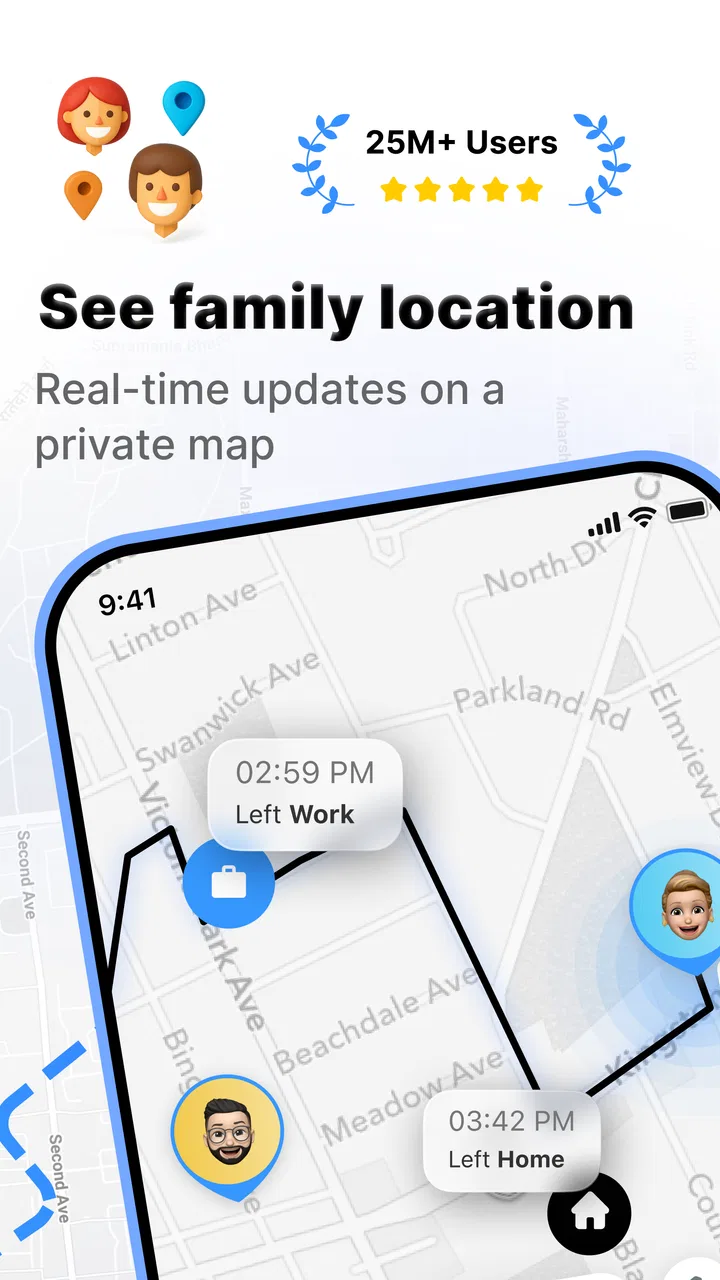
I found Find my Phone - Family Locator most useful when I treated it as a shared family-safety tool rather than a magic solution for every lost-device problem. Its purpose is straightforward: help people link and locate family members in real time, with the phone acting as the practical window into where someone is. That makes it relevant to parents, couples, relatives, and trusted groups who need a simple way to stay aware of one another while moving around.
My experience with it is shaped by one important reality: a location app is only as useful as the connection between the people using it. When the phone can communicate, the experience feels reassuring and immediate. When reception is weak, the battery is low, or someone has not opened the app or configured it properly, confidence drops quickly. I would therefore recommend it to families who want an extra layer of coordination, while reminding them that it should support conversation and common sense, not replace either one.
How Find my Phone - Family Locator feels in everyday use
The app sits in the Travel & Local category, but I think of it less as a travel guide and more as a mobile location companion. GEO TRACK LABS LTD has built it around a familiar need: knowing where a family member or personal phone is during ordinary movement. The store summary focuses on real-time child and family safety, and that emphasis is reflected in the situations where I found the concept most convincing.
You May Also Like

 Blood Strike: 2.5 Anniversary
Blood Strike’s Loadouts Turn Every Drop Into a Tactical Gamble
A close look at Blood Strike’s custom loadouts: how fast access to signature weapons reshapes its battle royale rhythm, rewards preparation, and narrows the gap between fights.

 Pandora - Music & Podcasts
Pandora’s Music Is Easy to Start, but Harder to Recover
Pandora’s strength is its low-effort path from a seed to a station. Its weak spot is how much confidence it asks you to place in connection, setup, and quiet recovery.

 8 Ball Pool
 Is Built on Rivalries, Rematches, and Routine
A close look at the rivalries, rematches, shared routines, and unanswered safety questions that turn a quick pool match into a persistent mobile community.

 Samsung Music
’s Quiet Strength Is Playing What You Already Own
Its reach comes less from spectacle than from dependable access to a personal library. That simplicity is both the app’s strongest retention engine and its ceiling.

 AccuWeather: Weather Radar
AccuWeather Review: A Quick, Clear Forecast for Everyday Decisions
For everyday plans, the best forecast is the one you can understand quickly. AccuWeather makes rain timing, radar, and local conditions easy to act on, with a few trade-offs.

 Hill Climb Racing
Why Hill Climb Racing Still Turns Crashes Into One More Run
A tiny car, a bumpy hill and one more upgrade: Hill Climb Racing keeps resurfacing because its simple chaos makes every near-miss feel personal.
More From Our News Desk
View All News


Imagine a parent collecting a child after an activity. Instead of sending several messages asking where the child is standing, the parent can use the family location workflow to get a better sense of the meeting point. Or consider two adults arriving separately at a busy station. A location view can reduce the back-and-forth that often happens when landmarks are crowded or one person is walking toward the wrong entrance. These are small moments, but they are exactly where a location-sharing app earns its place.
The app is free to install and available to an Everyone audience, which makes it approachable for a broad household. It has more than ten million installs and an average rating of 4.4 from roughly 966 thousand ratings, so it clearly has substantial reach. I would not treat popularity as proof that it will suit every family, but it does suggest that the basic idea is easy for many people to understand.
One detail I appreciate is that the service is not limited to a single narrow travel scenario. The “Find my Phone” wording points toward recovering a misplaced device, while the family-locator purpose points toward keeping track of people. Those are related but different jobs. Before relying on it, I would decide whether my main goal was finding my own phone, coordinating with relatives, or monitoring a child’s journey. That decision affects how carefully I would set up contacts and explain expectations.
Connectivity is part of the experience, not a background detail
Real-time location sounds simple until a phone moves through places where mobile data is inconsistent. In a strong-signal area, updates can make a meeting feel much less stressful. In a basement, rural road, crowded venue, or building with poor reception, the information may be delayed or less useful. I would never interpret a quiet or unchanged map as automatic proof that a person has stopped moving. It may simply reflect a communication gap.
This is the first practical habit I would recommend: agree on a backup message or meeting point before anyone sets out. The app can improve awareness, but it should not be the only plan for a child returning from school, a relative traveling alone, or a group splitting up at an event. A location display is helpful context; it is not a guarantee of contact.
Connectivity also influences battery decisions. A family member who is trying to conserve power may disable mobile functions or avoid using the phone, which can reduce the usefulness of any live-location workflow. I found that the best approach is to use the app as part of a broader routine: charge the phone before a long journey, keep important numbers available, and tell the group when someone expects to be unreachable.
This trade-off matters because the app’s strongest promise is also its most demanding one. Live awareness depends on phones being powered, configured, and able to communicate. If a household wants a completely independent safety device or a professional emergency-monitoring system, this is not the category I would choose. For everyday family coordination, however, that dependence is manageable when everyone understands it.
Useful mobile contexts beyond the obvious map check
I found the idea most useful during transitions. Leaving school, changing trains, walking from a car park, arriving at a festival, and meeting after shopping are all moments when people are moving and plans become vague. A quick location check can answer a practical question: should I wait here, start walking, or contact the other person? That is more valuable than constantly watching a map without a clear purpose.
For families, I would create a simple rule around privacy and attention. Use the app when there is a genuine coordination or safety reason, rather than checking repeatedly out of habit. That keeps the tool from becoming a source of tension. A child may accept location sharing more readily when the family explains exactly when it helps, such as during a journey home, instead of presenting it as unlimited observation.
For couples or adult relatives, the same principle applies. Location sharing can be convenient when one person is driving or arriving late, but it should be mutual and understood by everyone involved. The app is not a substitute for consent, and I would avoid setting it up secretly or using it to pressure someone into answering immediately.
A less obvious use is coordinating a group that does not want to exchange constant descriptive messages. At a large outdoor place, “I’m near the entrance” can mean several different things. A live location view may narrow the search, but I would still combine it with a visible landmark or a short text. GPS-style positioning can place someone in the right general area without identifying the exact door, floor, or side of a building.
The short description, “Find my Phone,” also makes the app relevant when the problem is a misplaced handset rather than a family outing. That use case needs realistic expectations. If the phone is nearby and able to communicate, a location tool may point you in the right direction. If the handset is out of power, disconnected, or moved by someone else, the result may not solve the problem. I would use it as one step in a search, not as a promise that every lost phone can be recovered.
What happens when the connection fails
Failure recovery is where I judge location apps more seriously. The first thing I would do after seeing an old or unhelpful position is avoid jumping to conclusions. I would check whether the person can answer a call or message, ask for a landmark, and confirm whether the phone still has power. If the situation is genuinely urgent, I would use the appropriate emergency channel rather than waiting for a consumer location app to update.
For a routine meeting, the recovery process can be much calmer. I would set a fixed fallback point, such as the main entrance or a named café, and give everyone a time window. If the app stops being useful, the group still has a plan. This is one of the most important ways to avoid turning a minor connectivity problem into a stressful search.
I would also test the family setup before relying on it during a trip. Each person should know which account or group they belong to, how to open the relevant view, and what a stale location means. A short practice run near home is more useful than discovering a setup problem when someone is already late. The app’s current version is 6.35.2, and keeping software current is sensible, although an update cannot fix every issue caused by signal, battery, or phone settings.
Another recovery habit is to avoid treating a single location point as precise evidence. A phone may appear close to a destination while the person is inside a large building or on a different level. I would use the map to narrow the search, then switch to a call, message, or agreed landmark. That combination is faster and less frustrating than repeatedly refreshing the same screen.
There is also a human failure mode: people may forget that they are sharing, misunderstand who can see them, or assume the app is active without checking. I would make the arrangement explicit when adding relatives. Everyone should know what the group is for, when it is expected to be used, and how to ask for a change. That clarity is just as important as the technical setup.
Privacy, purchases, and sensible household rules
Because this app deals with family whereabouts, I would pay closer attention to privacy than I would with a basic weather or map application. I would only include people who understand the arrangement, and I would avoid adding casual acquaintances simply because the app makes it possible. The safest setup is usually the smallest group that genuinely needs the information.
I would also look at the app’s settings carefully after installation rather than tapping through every prompt automatically. Location tools can become uncomfortable when people do not understand when sharing is active or who receives updates. The practical goal should be predictable communication, not silent surveillance. For children, parents should explain the purpose in age-appropriate language and revisit the arrangement as circumstances change.
The app itself is free, but optional in-app purchases range from $2.99 to $59.99 per item. That makes it important to inspect any purchase screen and understand what an optional upgrade changes before paying. I would begin with the free experience and only consider spending money if a feature directly solves a problem my household actually has. A higher price does not automatically make location information more accurate when the real limitation is poor reception or a dead battery.
Families should also decide who is responsible for responding when a location looks unusual. A map can prompt a conversation, but it cannot explain why someone took a different route. I would avoid making accusations based solely on a dot moving in an unexpected direction. Calling the person first is both more reliable and more respectful.
For adult users who dislike ongoing location sharing, this may not be the right choice. A conventional messaging app with occasional check-ins could be better for a privacy-conscious couple or a group that only needs to coordinate at specific times. Likewise, people who need formal fleet tracking, workplace management, or emergency-grade monitoring should look for a specialist service designed for those responsibilities.
Who will benefit most from this app?
I think it suits families that regularly coordinate across separate phones and want something more visual than a chain of text messages. Parents arranging pickups, relatives checking that someone has reached a destination, and couples meeting in busy places are natural users. It can also help people who misplace their own phone and want a location-focused way to begin looking.
The best candidates are comfortable with smartphones and willing to establish clear sharing rules. The app becomes much less useful when only one person understands it, when family members refuse to keep their phones charged, or when everyone expects the map to work perfectly in every environment. A short setup conversation can make a bigger difference than endlessly adjusting the app.
I would be more cautious about recommending it to someone who wants a completely passive safety system. The experience still depends on ordinary mobile conditions and on people participating in the arrangement. It is also not ideal for someone who finds location sharing intrusive, even when it is technically convenient. In that case, scheduled check-ins may offer a better balance.
Compared with ordinary map applications, this app is more focused on the family relationship and the “where is my phone or relative?” question. A standard map is excellent for directions and places, but it may require more manual sharing and messaging to coordinate a group. Compared with simple messaging, a location-oriented tool can reduce vague descriptions, although messages remain essential when the map is delayed or someone needs to explain a change of plan.
That distinction is why I would not replace every other tool with it. Navigation, calls, text messages, and emergency services each solve different problems. Find my Phone - Family Locator is strongest in the narrow space between them: ongoing awareness and practical coordination among trusted people.
My final view after weighing convenience against dependence
After looking at the way connectivity shapes the experience, I see this as a useful family-locator app with a clear everyday role. Its reach is substantial, its audience rating is Everyone, and its free entry point lowers the barrier to trying it. GEO TRACK LABS LTD has positioned it for people who want a direct way to link and locate phones within a family context, and that focus makes sense for routines such as pickups, arrivals, and meeting in crowded places.
My recommendation comes with one condition: treat the location display as helpful information, not absolute truth. Signal, battery, phone settings, and human behavior all affect what you see. The smartest setup combines the app with agreed meeting points, direct communication, and a respectful sharing policy. If a connection fails, the household should still know what to do next.
I would choose it for a family that wants more awareness than occasional check-in messages provide, especially when several people travel separately. I would skip it for anyone seeking professional monitoring, guaranteed recovery of a disconnected phone, or a solution that works independently of mobile connectivity. Used within its limits, though, it can remove a surprising amount of everyday uncertainty.
Overall, I see the app as a practical addition to a family’s communication habits rather than a replacement for them. Start with the free version, set expectations before sharing locations, test the workflow near home, and pay attention to how the app behaves in the places your family actually visits. The best result comes from combining location awareness with a clear human backup plan.
FAQs for Find my Phone - Family Locator
01How does Find My Phone - Family Locator ensure user privacy?
Find My Phone - Family Locator prioritizes user privacy by using encrypted data transmission and requiring user consent for location sharing. The app only shares location data with approved contacts, ensuring that your movements are not tracked without permission. Users can also manage privacy settings and control who can view their location at any time.
02Can Find My Phone - Family Locator work without an internet connection?
Find My Phone - Family Locator primarily relies on an internet connection to provide real-time location updates. However, it can also use GPS signals to track the last known location of a device. For optimal performance and accuracy, a stable internet connection is recommended when using the app.
03Is it possible to use Find My Phone - Family Locator across different platforms?
Yes, Find My Phone - Family Locator is designed to be compatible across different platforms, including both Android and iOS devices. This cross-platform functionality allows users to easily connect with family members regardless of their device type, ensuring seamless location tracking and communication.
04What are the main features of Find My Phone - Family Locator?
The app offers a variety of features including real-time location tracking, location history, geofencing alerts, and emergency SOS functions. Additionally, it provides options for setting safe zones and receiving notifications when family members enter or leave these areas. These features are designed to enhance safety and communication among family members.
05Are there any subscription fees for using Find My Phone - Family Locator?
Find My Phone - Family Locator typically offers a free version with basic features. For advanced features like unlimited location history, premium customer support, and additional custom alerts, users may choose to subscribe to a premium plan. Pricing details can vary, so it’s advisable to check the app store for the latest subscription options.
Pros
- Accurate real-time location tracking.
- User-friendly interface design.
- Cross-platform compatibility.
- Customizable alerts for movement.
- Battery-saving mode available.
Cons
- Requires constant internet connection.
- Limited features in free version.
- Can drain battery quickly.
- Privacy concerns for some users.
- Occasional location inaccuracies.

Find my Phone - Family Locator
Gallery